Showing posts with label Future of space travel. Show all posts

Friday, 21 September 2012

The Space race is a private affair...

I am not opposed to sending untrained tourists to outer space as many people like to think that the romance of space travel lives up to the Hype. As Virgin Airlines CEO, Richard Branson goes on CBS news he make a bold statement of population of Mars. Making plans to be among the first of the few people to fly into low earth orbit at $200,000, hoping that the money earn from that adventure will lead to bigger and better things.
He is not alone in this prediction of future travel, as Elon Musk co-founder of PayPal and CEO of Tesla Motors and spaceX, mentions his interest. SpaceX recently signed a contract with NASA, agreeing to re-stock the International Space Station for twelve missions. In terms of sustaining human life on Mars, Musk explained, "You need to live in a dome initially but over time you could terraform Mars to look like Earth and eventually walk around outside without anything on. ... So it's a fixer-upper of a planet." "In order for us to have a future that's exciting and inspiring, it has to be one where we're a space-bearing civilization."
Sadly recent plans for the US government to cut the budget of Nasa for the next year or so will probably stop future plans for any unmanned Mars missions. While governments pull out of the space race, alternatively the commercial sector step up plans to create a need to go into space. Nasa has already asked  three companies to transport cargo into space on a pay by mission contract. Sierra Nevada Corporation, headquartered in Louisville, Colo. Space Exploration Technologies (SpaceX), headquartered in Hawthorne, Calif and The Boeing Company, headquartered in Houston.
Emerging companies around the world seem to have a converged their dates for a regular space-flight infrastructure to a few years from now.
Virgin Galactic has already collected deposits from more than 500 customers willing to pay $200,000 for a seat aboard SpaceShip Two. Virgin officials say they hope to begin rocket-powered flight tests of SpaceShip Two later this year, with commercial operations perhaps starting in 2013 or 2014.

XCOR Aerospace's Lynx is a two-person suborbital space plane designed to take off and land on a conventional airport runway. XCOR has already signed a deal with the Southwest Research Institute, a nonprofit organization based in Boulder, Colo., to fly some of its scientists and experiments to suborbital space. The Lynx could be in flight-test operations by the end of 2012, according to XCOR officials. The company plans to charge $95,000 per seat when the space plane is up and running.

Armadillo Aerospace, a Texas-based company founded by computer game entrepreneur John Carmack, is developing a vertically launched spaceship for suborbital flights. Armadillo's spacecraft will have room for two passengers. The space tourism firm Space Adventures is booking seats on the craft for $110,000 each. An Arizona man recently won a free flight on the vehicle in a contest sponsored by Space Adventures and Seattle's Space Needle, though the date of his trip has yet to be set.
The Nevada-based Bigelow Aerospace designs and builds large, expandable habitats that it aims to link up in orbit, creating private space stations.
Bigelow has already launched two prototype test habitats into orbit, one in 2006 and one in 2007. The company's current module, the six-person BA 330, provides about 11,650 cubic feet (330 cubic meters) of usable volume. Bigelow envisions joining at least two BA 330s together in space. The company has separate partnerships with Boeing and SpaceX, whose craft would ferry passengers to and from Bigelow's huge space hotels. Potential clients include space agencies, government departments and research groups.

Microsoft co-founder Paul Allen recently teamed up with pioneer aerospace engineer Burt Rutan on a venture called Stratolaunch Systems. The company plans to launch rockets into space from a carrier plane that would be the biggest aircraft in history, with a wingspan of 385 feet (117 meters). Stratolaunch aims to send cargo and satellites into space initially, but it hopes to launch astronauts eventually as well. The firm is aiming for an initial test flight in 2015, with a first operational launch coming in 2016.
ATK teaming up with Lockheed Martin and European aerospace firm Astrium on the venture, which would use the 300-foot-tall (91-meter) Liberty rocket to blast a seven-passenger capsule into orbit. ATK is aiming to begin test flights of the Liberty system in 2014, with the first manned mission expected to occur in late 2015, officials said. If all goes well, Liberty could be available to NASA and other potential customers by 2016.

Blue Origin, a secretive company set up by Amazon.com founder Jeff Bezos, hopes to win a NASA contract to ferry astronauts to and from the International Space Station with its Space Vehicle. The Space Vehicle is a biconic craft designed to carry seven passengers, or a mix of cargo and crew. Blue Origin is developing a reusable first-stage booster to help get the Space Vehicle to orbit relatively cheaply. Company officials have said the Space Vehicle should be ready to begin commercial operations between 2016 and 2018. Blue Origin is also working on a suborbital spacecraft called New Shepard, which would be launched by a reusable propulsion module.
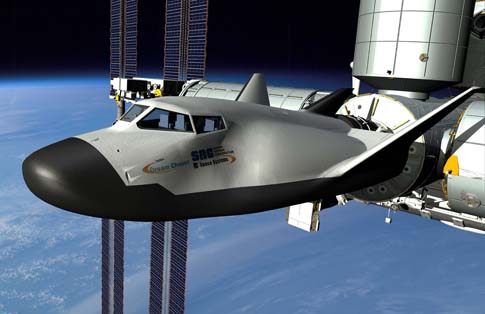
Sierra Nevada's Dream Chaser is a small space plane designed to carry seven astronauts to and from low-Earth orbit. The spacecraft, which is based on a NASA concept vehicle from the 1980s called the HL 20, will launch vertically atop a rocket but land on a runway like an airplane. NASA's CCDev program granted Sierra Nevada more than $100 million in the past two years to aid in the Dream Chaser's development. Company officials say the space plane should be ready to begin operations by 2016.
Aerospace giant Boeing is developing a space capsule called the CST-100 to ferry astronauts to and from the International Space Station and other destinations in low-Earth orbit. NASA's CCDev program has invested roughly $120 million in the CST-100, which is designed to seat up to seven passengers. The capsule, which measures 14.8 feet (4.5 meters) across at its widest point, utilizes proven technology from NASA's Apollo and space shuttle programs, Boeing officials have said. The CST-100 is expected to make ground landings, though it will also be capable of splashdowns in emergency situations. Each capsule is designed to make 10 space-flights, and the CST-100 could be operational by 2016.
SpaceX is also working on a crewed version of Dragon, which would carry up to seven astronauts to the orbiting lab or deep space destinations such as Mars. SpaceX CEO Elon Musk has said he founded the company with the primary goal of helping make humanity a multiplanet species.
Gov. Jerry Brown announced he had signed legislation intended to boost the fledgling private space travel industry. Brown said he had signed the bill by Republican Assemblyman Steve Knight, which limits private space companies' liability from civil lawsuits.
Under AB2243, the companies cannot be held liable for the injury or death of customers because of the obvious risks associated with space travel. They still can be sued in cases of gross negligence or willful disregard for participants' safety. The bill also does not limit the ability to sue parts manufacturers. Brown said the legislation will allow companies such as SpaceX, Virgin Galactic and the Spaceship Company "to innovate and explore without the worry of excessive liability."

Wheels are in motion for space travel, allowing fledging companies to build a travel infrastructure. only time will tell if those companies will survive the next ten years or so. Inventor Alan Bond co founder of Reaction Engines LTD estimates 10 years until a working prototype for a new type of rocket engine, that will easy fly in space and in earths atmosphere. This type of engine privately funded by the same people with investment in space, could bring prices down. So while Companies are rushing to plan a Space-Agency with the Available technology, The real Age of space Travel will likely to start in Ten years, when SKYLON goes online.


Sunday, 5 August 2012

Space Propulsion, current and future methods

The run up to Mars rover landing, makes me think about propulsion in the methods it took to move a 900kg machine across 354 million miles to a neighboring planet. The journey time took 8 and a half months with a 14 minuet delay for communications with earth. There are seems to two methods for propulsion both have advantages and disadvantages.

In rocket engines, the reaction also releases heat which will warm up the product. Since when you heat a substance it expands (try this with a crayon and a magnifying glass), the heat produced by the chemical reaction heats up the product, making it expand. As it expands, it gets too big for the reaction chamber and pushes out the back of the rocket. This provides thrust for the rocket.
Current space-flight depends on a rocket that burns fuel and oxidizer, which turns out to be both expensive and deficient as a means of propulsion for long-distance space travel, explains Lozano. Chemical-based rockets get terrible fuel efficiency, achieving very little thrust per kilogram of propellant used, and their exhaust velocity can’t exceed 5,000 meters per second. Using these tools, Lozano adds, it would take at least nine months to get to Mars (if your timing and the planets’ alignment are just right), and “the rockets would be huge compared to the payload.”


Electromagnetic propulsion (EMP), is the principle of accelerating an object by the utilization of a flowing electrical current and magnetic fields. The electrical current is used to either create an opposing magnetic field, or to charge a fluid, which can then be repelled. It is well known that when a current flows through a conductor in a magnetic field, an electromagnetic force known as a Lorentz force, pushes the conductor in a direction perpendicular to the conductor and the magnetic field. This repulsing force is what causes propulsion in a system designed to take advantage of the phenomenon. The term electromagnetic propulsion (EMP) can be described by its individual components: electromagnetic- using electricity to create a magnetic field (electromagnetism), and propulsion- the process of propelling something. One key difference between EMP and propulsion achieved by electric motors is that the electrical energy used for EMP is not used to produce rotational energy for motion; though both use magnetic fields and a flowing electrical current.

plasma-based propulsion system. An electric power source is used to ionize fuel into plasma. Electric fields heat and accelerate the plasma while the magnetic fields direct the plasma in the proper direction as it is ejected from the engine, creating thrust for the spacecraft. The engine can even vary the amount of thrust generated, allowing it to increase or decrease its acceleration. It even features an "afterburner" mode that sacrifices fuel efficiency for additional speed. Possible fuels for the VASIMR engine could include hydrogen, helium, and deuterium.

The use of hydrogen as the fuel for the VASIMR project has many side benefits, according to researcher Franklin Chang-Diaz. In addition to being the director of the Advanced Space Propulsion Laboratory, Chang-Diaz is an astronaut who has flown into space on seven missions, more than any other NASA astronaut. "We're likely to find hydrogen pretty much anywhere we go in the solar system," he said. What this means is that a VASIMR-powered spacecraft could be launched with only enough fuel to get to its destination, such as Mars, and then pick up more hydrogen upon arrival to serve as fuel for the return trip home. Another benefit of hydrogen fuel is that hydrogen is the best known radiation shield, so the fuel for the VASIMR engine could also be used to protect the crew from harmful effects of radiation exposure during the flight.
Electrical power sources for the VASIMR engine could include such things as a nuclear power system or solar panels. For long-range flights, Chang-Diaz said, the best option is nuclear power. "Nuclear power is definitely a must if we're going to go to Mars," he said. This means that VASIMR could be integrated with NASA's recently announced Project Prometheus proposal to develop nuclear power generators for space-flight.

The future of space propulsion maybe in the use of plasma pushed by the repelling force of magnetism.
But o achieve his much-repeated claim that VASIMR could enable a 39-day one-way transit to Mars, Chang Diaz posits a nuclear reactor system with a power of 200,000 kilowatts and a power-to-mass ratio of 1,000 watts per kilogram. In fact, the largest space nuclear reactor ever built, the Soviet Topaz, had a power of 10 kilowatts and a power-to-mass ratio of 10 watts per kilogram. There is thus no basis whatsoever for believing in the feasibility of Chang Diaz’s fantasy power system.

Chang Diaz’s hypothetical 200,000-kilowatt nuclear electric spaceship would have a launch mass of 7,700 metric tons, including 4,000 tons of very expensive and very radioactive high-technology reactor system hardware requiring maintenance support from a virtual parallel universe of futuristic orbital infrastructure. Yet it would still get to Mars no quicker than the 6-month transit executed by the Mars Odyssey spacecraft using chemical propulsion in 2001, and which could be readily accomplished by a human crew launched directly to Mars by a heavy-lift booster no more advanced than the (140-ton-to-orbit) Saturn 5 employed to send astronauts to the Moon in the 1960s.
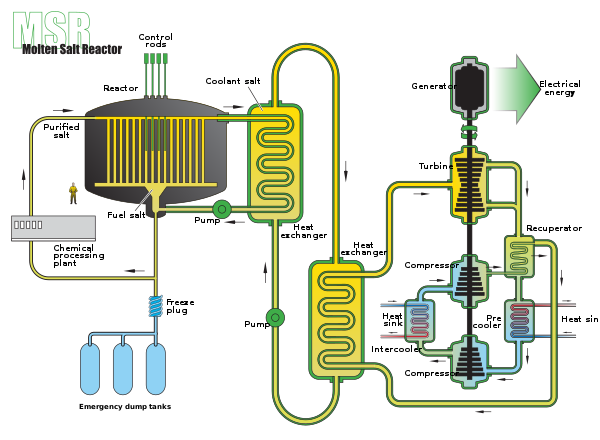
It would suggest that nuclear power is needed to make the electrical energy to power such a propulsion engine like Vasimir. The current nuclear reactor technology is both lethal and complex to run, though one such technology like the thorium reactor could might work. The forgotten research to put a working reactor in a aircraft in the 1950's could supply the electrical energy needed in such a engine. There are no such plans in the pipeline to put reactor technology in space for propulsion test. But I an ever hopeful that someone would make the connection and propose plans even for a propulsion test.