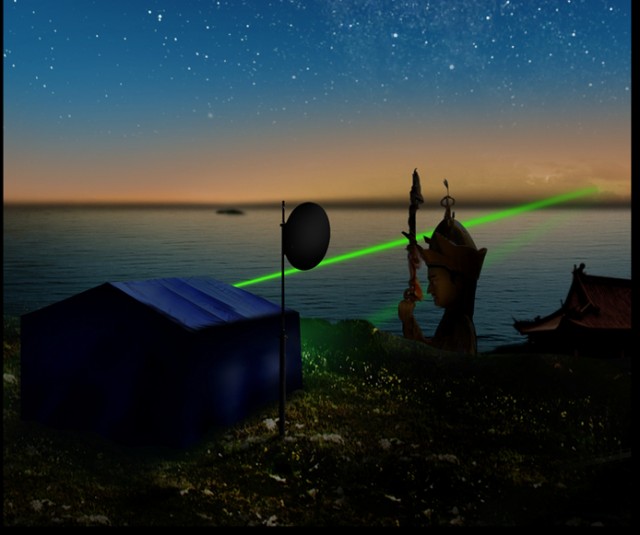
 consider the quantum teleportation space race where by countries around the world are investing time and millions of dollars into the technology, which uses satellites to beam bits of quantum information down from the sky and and could profoundly change worldwide communication.
This is not a maybe-sort-of-one-day quantum technology. Quantum teleportation has been proven experimentally many times over and researchers are now eyeing the heavens as their next big leap forward. Most of what remains are the nuts and bolts engineering challenges ( before it becomes a thing of the present.
consider the quantum teleportation space race where by countries around the world are investing time and millions of dollars into the technology, which uses satellites to beam bits of quantum information down from the sky and and could profoundly change worldwide communication.
This is not a maybe-sort-of-one-day quantum technology. Quantum teleportation has been proven experimentally many times over and researchers are now eyeing the heavens as their next big leap forward. Most of what remains are the nuts and bolts engineering challenges ( before it becomes a thing of the present.Though it may be disappointing to hear, quantum teleportation is not about instantly sending a person or object between two places. Instead, the technique involves the quantum entanglement, where by if a pair of photons was to be separated at large distances effecting one will effect the other. The longest distance so far for teleportation is 101 km with a photon source in the middle, the end receivers can send information.
In the past year, a team from China and another in Austria set new records for quantum teleportation, using a laser to beam photons through the open air over 60 and 89 miles, respectively. This is many times farther than the previous record of 10 miles, set in 2010 by the same Chinese team. With scientists extending quantum teleportation to such distances, many are already considering the next step: zapping particles and information from an orbiting satellite to a relay station on Earth.
If developed, quantum teleportation satellites could allow spies to pass large amounts of information back and forth or create unhackable codes. Should we ever build quantum computers – which would be smaller and exponentially more powerful than modern computers, able to model complex phenomenon, rapidly crunch numbers, and render modern encryption keys useless – they would need quantum teleporters in order to be networked together in a quantum version of the internet. China plans to launch a satellite with a quantum teleportation experiment payload in 2016 and the European, Japanese, and Canadian space agencies are hoping to fund their own quantum teleportation satellite projects in the coming years.
 As well as the possibilities of future tech there are far fetched ideas that people are working on, like Dr Harold White of NASA's Johnson Space Center. Using a White-Juday Warp Field Interferometer a warp coil " which looks like a magnetic coil loop, will attempt to warp a laser beam in a sensitive interferometer array. Any warp in space with move the laser and the slight movement will change the light pattern. But laughing aside the magnetic field moving light experiment seems to me like a waste of any body's time. But still the theory of a real-life warp drive as first discussed in scientific terms in 1994 by Mexican physicist Miguel Alcubierre, seem plausible and is worth keeping in mind.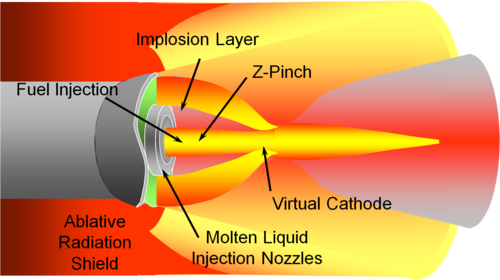
To hit this phenomenal speed, the researchers are investigating something called z-pinch fusion as a source of propulsion. Cortez says the technique takes a cylindrical array of super-thin lithium wires and puts a massive electric current through them. The electricity—millions of amps are being sent through the wires in 100 nanosecond pulses, which could produce 3 terawatts of output power—creates a magnetic field around the array and vaporizes the wires to form plasma.
 The magnetic field pinches the plasma until it collapses on a core of deuterium and lithium, which they hope will cause its atoms to fuse and result in a massive release of energy.
“What we’re aiming for is to get enough compression and heat in the z-pinch implosion to cause the fusion fuel to react,” Cortez says. “With the energy that would release, we could get millions of pounds of thrust out the back of this thing—on the order of Saturn-V-class thrust.”
The magnetic field pinches the plasma until it collapses on a core of deuterium and lithium, which they hope will cause its atoms to fuse and result in a massive release of energy.
“What we’re aiming for is to get enough compression and heat in the z-pinch implosion to cause the fusion fuel to react,” Cortez says. “With the energy that would release, we could get millions of pounds of thrust out the back of this thing—on the order of Saturn-V-class thrust.”Z pinch machines have yet to break even the energy taken from the out, compared to energy put into the system. Nuclear fusion is not a reliable power source yet as the enormous temperatures need to heat the plasma cant be contained my a magnetic field.
 The best idea or experiment for a reactor is the The ITER fusion reactor, with self correcting plasma shape system, which wont be built until 2019. The down side as well is that it's not even a Z pinch design but a round donut shape.
The best idea for a thrust system in space beside the inefficient oxygen hydrogen rockets, is a plasma thrust (Vasimir) system. This requires a lot of power at least 200 megawatts, which cant be provided by solar or any current battery technology. Nasa reluctance to use Nuclear power, means that decent space travel will be limited to chemical propulsion. Star-trek ideas however you look at it, seems to be making its mark to shaping a future. Whether or not we get the same idealized future is anyones guess. But similar gadgets like the Universal translator, the tablet, handheld communicators, Bionic eyes, telepresence, transparent aluminum and hypo spray are working into our lives right now!!!. Without a some guide from science fiction, I would guess technology would grow and evolve naturally. But my suspicions would conclude that science would probably change at a slower rate without Sci Fi...