Showing posts with label The science of Hurricanes. Show all posts

Sunday, 4 November 2012

Weather modification, a brief history


Weather modification is the act of intentionally manipulating or altering the weather. The most common form of weather modification is cloud seeding to increase rain or snow, usually for the purpose of increasing the local water supply. Weather modification can also have the goal of preventing damaging weather, such as hail or hurricanes, from occurring; or of provoking damaging weather against an enemy or rival, as a tactic of military or economic warfare. Weather modification in warfare has been banned by the United Nations.

Cloud seeding is a common technique to enhance precipitation. Evidence on its safety is strong, but there are still doubts about its effectiveness. Cloud seeding entails spraying small particles (like silver iodide) onto clouds in order to affect their development, usually with the goal of increasing precipitation. Cloud seeding only works to the extent that there is already water vapor present in the air. Critics generally contend that claimed successes occur in conditions which were going to lead to rain anyway. It is used in a variety of drought-prone countries, including the United States, the People's Republic of China, India, and Russia. In the People's Republic of China there is a perceived dependency upon it in dry regions, and there is a strong suspicion it is used to "wash the air" in dry and heavily polluted places, such as Beijing. In mountainous areas of the United States such as the Rocky Mountains and Sierra Nevada, cloud seeding has been employed since the 1950s.
On 13 Oct 1947, the U.S. Military (as part of Project Cirrus involving General Electric) dropped 80 kg of dry ice into a hurricane in the Atlantic Ocean, safely off the eastern coast of the USA. The hurricane changed direction and traveled inland, where it did extensive damage to property in Georgia. The U.S. military classified the data from the seeding of this hurricane to frustrate litigation.
Langmuir believed that there was approximately a 99% probability that this hurricane's change of direction was the result of the cloud seeding. Langmuir's opinion about the effect of the cloud seeding on this hurricane is not mentioned in any of his publications in scientific journals, but is mentioned in the 1953 final report on Project Cirrus, which was classified by the U.S. Military. It is likely that attorneys for General Electric directed Langmuir not to make any public admission that cloud seeding caused the hurricane to change direction, in order to avoid litigation against General Electric by victims of the hurricane.

New Mexico between November 1949 and July 1951. Langmuir claimed that the release of silver iodide modified the weather, not only in the state of New Mexico, but also more than 1000 kilometers downwind. Langmuir's claim was rejected by the meteorological community, because Langmuir's evidence was inadequate.
The release of  silver iodide AgI "was discontinued in July, 1951 during the great floods in Kansas and adjacent states. The 13 July 1951 flood at Kansas City was described as "the most devastating flood in the nation's history"; 17 people died as a direct result of that flood, despite weather forecasts and warnings. (Alexander, 1951) It is still unknown what effect, if any, the AgI release in New Mexico had on rain and floods in Kansas.

The modern consensus of meteorologists seems to be that the release of AgI in New Mexico probably had no effect on the rainfall/floods in Kansas, but if there was an effect, the effect would be only a small enhancement of the total rainfall.
Langmuir sincerely believed that AgI release was modifying weather at long distances from the point of release, yet he continued to engage in such weather modification for two years, despite the possibility of harm from such modification, and despite the lack of consent by affected people.
Despite Langmuirs mixed results modification of the weather was still believed to be achievable. Project Stormfury was an attempt to weaken tropical cyclones by flying aircraft into storms and seeding the eyewall with silver iodide. The project was run by the United States Government from 1962 to 1983. A similar project using soot was run in 1958, with inconclusive results. Various methods have been proposed to reduce the harmful effects of hurricanes. Moshe Alamaro of the Massachusetts Institute of Technology proposed using barges with upward-pointing jet engines to trigger smaller storms to disrupt the progress of an incoming hurricane; critics doubt the jets would be powerful enough to make any noticeable difference.
Alexandre Chorin of the University of California, Berkeley, proposed dropping large amounts of environmentally friendly oils on the sea surface to prevent droplet formation. Experiments by Kerry Emanuel of MIT in 2002 suggested that hurricane-force winds would disrupt the oil slick, making it ineffective. Other scientists disputed the factual basis of the theoretical mechanism assumed by this approach. The Florida company Dyn-O-Mat proposes the use of a product it has developed, called Dyn-O-Gel, to reduce the strength of hurricanes.
The substance is a polymer in powder form which reportedly has the ability to absorb 1,500 times its own weight in water. The theory is that the polymer is dropped into clouds to remove their moisture and force the storm to use more energy to move the heavier water drops, thus helping to dissipate the storm. When the gel reaches the ocean surface, it is reportedly dissolved. The company has tested the substance on a thunderstorm, but there has not been any scientific consensus established as to its effectiveness. Hail cannons have been used by some farmers since the 19th century in an attempt to ward off hail, but there is no reliable scientific evidence to confirm their effectiveness. Another new anti-hurricane technology is a method for the reduction of tropical cyclones’ destructive force  pumping sea water into and diffusing it in the wind at the bottom of such tropical cyclone in its eyewall.
Between 1962 and 1983 Project STORMFURY  seeded eight hurricanes with silver iodide. The theory was that it would cause super cooled water in the hurricane to freeze cause rain bands around the eyewall to grow rapidly and essentially "smother" the eyewall. It didn't work simply because there was not sufficient super cooled water in a hurricane and on the few occasions where it seemed to work, the old eyewall died and was replaced with a new one - sometime which has turned out to be a natural feature in major hurricanes.
In 2008, the Department of Homeland Security (DHS) started investigating ways to collaborate with scientists in an effort to moderate the land damage hurricanes can cause, as well as modifying a hurricane’s path and reducing their intensity. Ultimately, DHS decided not to invest in field tests and new technologies for weather modification was dropped. One reason for this, according to William Laska, program manager at the DHS’s Science and Technology Division, is that “geo-engineering” remains “distasteful” to many scientists and government agencies. Referring to how Project Stormfury has intensified the reluctance to investigate and fund technologies for hurricane modification, William Laska told Earth Magazine:

"Waving the modification/mitigation flag we got a lot of doors slammed in our face." She added, "There’s still a sour taste from Stormfury."

Judging by the effects of Hurricane Sandy and the amount of money in damages a hurricane can cause. It may be possible in theory to rob the heat of a hurricane thus dissipating the energy a super storm regardless of the eyewall regrowing or not. The theory is to have a large plane with a big tank of liquid nitrogen as a refrigerant to constantly cool the store of heat energy, which is usually the fuel that makes a hurricane devastating.
Other methods such as ionizing the air to discharge lightning, by using lasers or soot particles to prevent convectional currents, have been discussed by experts in in hope of preventing extreme weather conditions.
Perhaps in the future the research into weather modification will allow the prevention of hurricanes, reducing the the cost of damages. By then then project storm fury would be remembered as a pioneering project that pave way to weather projects that helped save lives...

Monday, 29 October 2012

The science of Hurricanes, let's try weather hacking


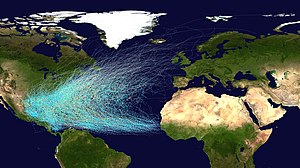
The two essential ingredients in every hurricane are warm water and moist warm air. That’s why hurricanes begin in the tropics. Hurricane season in the Atlantic begins June 1st and ends November 30th. The Eastern Pacific hurricane season begins May 15th and also ends November 30th. Most Atlantic hurricanes start to take shape when thunderstorms along the west coast of Africa drift out over warm ocean waters that are at least 80 degrees Fahrenheit (27 degrees Celsius), where they encounter converging winds from around the equator.
Hurricanes start when warm, moist air from the ocean surface begins to rise rapidly, where it encounters cooler air that causes the warm water vapor to condense and to form storm clouds and drops of rain. The condensation also releases latent heat, which warms the cool air above, causing it to rise and make way for more warm humid air from the ocean below. As this cycle continues, more warm moist air is drawn into the developing storm and more heat is transferred from the surface of the ocean to the atmosphere.
This continuing heat exchange creates a wind pattern that spirals around a relatively calm center, or eye, like water swirling down a drain. Converging winds near the surface of the water collide, pushing more water vapor upward, increasing the circulation of warm air, and accelerating the speed of the wind. At the same time, strong winds blowing steadily at higher altitudes pull the rising warm air away from the storm’s center and send it swirling into the hurricane’s classic cyclone pattern. High-pressure air at high altitudes, usually above 30,000 feet (9,000 meters), also pull heat away from the storm’s center and cool the rising air. As high-pressure air is drawn into the low-pressure center of the storm, the speed of the wind continues to increase. As the storm builds from thunderstorm to hurricane, it passes through three distinct stages based on wind speed:
  • Tropical depression—wind speeds of less than 38 miles per hour (61.15 kilometers per hour)
  • Tropical storm—wind speeds of 39 mph to 73 mph (62.76 kph to 117.48 kph)
  • Hurricane—wind speeds greater than 74 mph (119.09 kph)
This year, cyclone activity has continued longer than expected in the Atlantic, unperturbed by El Niño, which spawns high-level winds that stream eastward and can disrupt the swirling motion that gives a developing storm its power.
There was a strong indication that El Niño would form in time to suppress the peak of the hurricane season and El Niño just hasn't formed yet. The main reason for the recent abundance of cyclones is that since 1995, the Atlantic Ocean basin has been in the warm phase of a cyclical climate pattern called the Atlantic Multidecadal Oscillation, with hotter-than-average surface temperatures throughout the tropics and subtropics.
This pattern lasts for about 25-40 years, and comes with more hurricanes than its "cool" phase.
Warm water helps hurricanes form and fuels their strength.
In addition, in the past few years there has also been a strong West African monsoon, which creates disturbances in the eastern Atlantic that can turn into cyclones (the generic name for hurricanes and tropical storms).
There's also been relatively weak wind shear in the tropical Atlantic where cyclones form. Wind shear is a difference in wind speed or direction between the low and high atmosphere, which tears apart developing storms. Wind shear is the main way El Niño hampers cyclone formation. One thing that likely isn't to blame for the increase in hurricanes in recent years is global warming. Many climate models suggest that increased temperatures could actually lead to fewer, but stronger, hurricanes worldwide.
An average hurricane season has six hurricanes, but also about 25 hurricane days. The cyclones this year haven't been as strong as usual, with only one major hurricane, defined as Category 3 or stronger on the Saffir-Simpson scale.
 Better technology also allows us to detect more hurricanes than in the past. In recent decades satellites have significantly increased the detection of tropical storms that last less than 36 hours. This year there have been three tropical storms that lasted less than 1.5 days: tropical storms Helene, Joyce and Patty. These storms might have been missed in the pre-satellite era, and indeed, some storms actually could have been, meaning more seasons may have been as busy as this one has been. But regardless of what the hurricane season forecast is, people who live near the Atlantic or the Gulf of Mexico need to be prepared for storms.
While scientists agree on the mechanics of hurricane formation, and they agree that hurricanes are becoming more frequent and severe, that’s where consensus ends. Some scientists believe that human activity already has contributed significantly to global warming, which is increasing air and water temperatures worldwide and making it easier for hurricanes to form and gain destructive force. Other scientists believe that the increase in severe hurricanes over the past decade is due to natural salinity and temperature changes deep in the Atlantic part of a natural environmental cycle that shifts back and forth every 40-60 years.
While the scientific community debates the root cause of the temperature changes that are contributing to the current increase in destructive hurricanes, three things are apparent:
  • Air and water temperatures are rising worldwide. 
  • Human activities such as deforestation and greenhouse gas emissions from a wide range of industrial and agricultural processes are contributing to those temperature changes at a greater rate today than in the past. 
  • Failure to take action now to lower atmospheric levels of greenhouse gases is likely to lead to more frequent and severe hurricanes in the future.
Back in the 1960's Project Stormfury was an attempt to weaken tropical cyclones by flying aircraft into storms and seeding the eyewall with silver iodide. The project was run by the United States Government from 1962 to 1983. A similar project using soot was run in 1958, with inconclusive results.
The last experimental flight was flown in 1971, due to a lack of candidate storms and a changeover in NOAA's fleet. More than a decade after the last modification experiment, Project Stormfury was officially canceled. Although a failure in its goal of reducing the destructiveness of hurricanes, Project Stormfury was not without merit. The observational data and storm lifecycle research generated by Stormfury helped improve meteorologists' ability to forecast the movement and intensity of future hurricanes. Perhaps in recent years the increasing severity of hurricanes would require a man-made solution for weather modification. Considering the cost of prevention would prove to be less costly. The future suggests an increase in hurricanes with no end in sight of any other changes. The logical thing would be to open up old files of project storm-fury and look into ways of weather modification and prevention. By then we might have a chance of stopping a drought or reduce the destructive forces of a hurricane...