 In consideration to travel beyond the planet there seems to be a need to find other materials, when the local stock of minerals has run out. The motive to visit and create a moon-base there, will require a few things. Its essential to find a water source allowing the inhabitants to grown food there or to create rocket fuel for any spacecraft. Already top layer of the moon’s surface may hold far more water than previously thought, according to a new study.The newly released study has found that water was most likely formed on the surface of the Moon by the constant stream of charged particles ejected from the Sun. The finding “represents an unanticipated, abundant reservoir” of water on the moon, according to researchers from three U.S. universities, who formally reported their results Sunday in the journal Nature Geoscience.
In 2009, NASA bombed the moon -- part of its Lunar CRater Observation and Sensing Satellite (LCROSS) mission -- and observed grains of water ice in the remnants of the resulting plume, as well as light metals such as sodium and mercury, and volatile compounds like methane, ammonia, carbon dioxide, carbon monoxide and hydrogen.
While the study does not suggest a large amount of readily available water, it may be possible to mine water from the soil or to break up the molecules into their constituent oxygen and hydrogen atoms to create rocket fuel—potential requirements for a lunar base. “With the cost of $25,000 for taking one pint [half a liter] of water to the moon, it is essential that we develop processes of producing water from the materials on the moon,” said Dr. Lawrence Taylor, a University of Tennessee geochemist who advised Apollo astronauts gathering lunar samples.
The researchers concluded in the Nature Geoscience study that positively charged subatomic hydrogen proton particles coming from the solar wind -- a stream of charged particles ejected from the sun's upper atmosphere -- appear to have combined with oxygen on the moon's surface to form the OH hydroxyls.

 The price of the isotope helium-3 has skyrocketed from $150 per liter to $5,000 per liter.Helium wasn't technically "discovered" on Earth until about 1895, despite being abundant in the universe. Almost all of the global supply of helium is located within 250 miles of Amarillo, Texas; it's distilled from accumulated natural gas and extracted during the refining process. Since the 1920s, the US has considered its helium stockpile as an important strategic natural resource, amassing some 32 billion cubic feet in an underground bunker in Texas, but for several years now, it's been selling off that stockpile bit by bit to interested industrial buyers. Liquid helium cools infrared detectors, nuclear reactors, and the superconducting magnets used in MRI machines, too. The fear is that, at current consumption rates, that underground bunker will be empty within 20 years, leaving the earth almost helium-free by the end of the 21st century.
The prospect of fusion using helium-3, a rare helium isotope that is missing a neutron. Physicists have yet to achieve pure helium-3 fusion, but the International Thermonuclear Experimental Reactor soon to be built in 2019 is the best candidate to succeed. The basic reasons for Helium 3 is that using it along with other hydrogen isotopes will give less harmful neutrons in the reaction. The less neutron bombardment the longer the inner chamber will last, which will effectively be cheaper in the cost of maintenance.
The moon could also be a source for rare earth elements, such as europium and tantalum, which are in high demand on Earth for electronics and green energy applications (solar panels, hybrid cars), as well as being used in the space and defense industries.
China is the largest exporter of rare earth elements, but there are growing concerns over supply vulnerability as China drastically reduces its rare earth exports. Scientists know that there are pockets or rare earth deposits on the moon, but as yet they don't have detailed maps of those areas. Potassium, phosphorus and thorium are other elements that lunar rocks have to offer a potential mining venture.
The process of mining will also be need to revised Associate Professor of Engineering at University of New South Wales. Leonhard Bernold spoke of a close pneumatic system where by using the power of suction to extract the minerals. Possibly a directed gas supply is forcing loose rocks out for the suction pipe to extract while filtering and recycling the gas for more extraction. Once contained the sand-like particles can he heated and various elements can be removed and separated for their important uses. If such a machine could be made, it is more likely to be a automated system to reduce human risk as lunar rock is abrasive and could easily wear out a space suit.
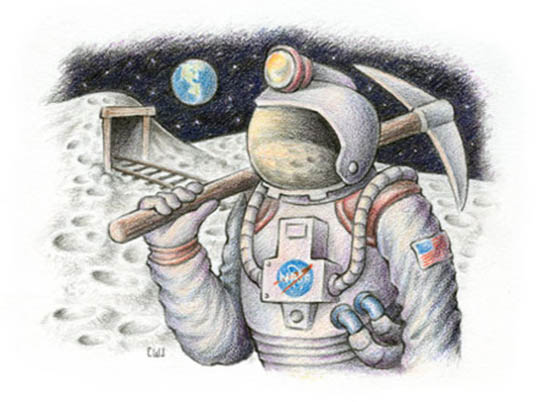
The benefits of mining the moon for a potential fuel source have never disappeared, considering Nasa finding water on the moon is the first step to colonizing any area. This whole venture actually requires several different emerging events to successfully happen. The success of space tourism for an orbital infrastructure (possibly the need for a rocket engine to fly from aerospace to outer space), a need for fusion fuel which requires fusion power to work (hopefully by 2019) and the hugh investment for a company or group to try and extract minerals from the moon. Potentially there is motive already mine the moon with out fusion fuel as I wrote an article about helium running out, which is essential for most things including cryo research and electronics manufacture. The pros and cons of mining other areas besides Earth become more favorable. If there are things to look forward to it will be success or failure of tourism in space that might indicate where the next frontiers of industry will be heading...