Flexible electronics, also known as flex circuits, is a technology for assembling electronic circuits by mounting electronic devices on flexible plastic substrates, such as polyimide, PEEK or transparent conductive polyester film. Additionally, flex circuits can be screen printed silver circuits on polyester. Flexible electronic assemblies may be manufactured using identical components used for rigid printed circuit boards, allowing the board to conform to a desired shape, or to flex during its use.
 These flexible printed circuits (FPC) are made with a photolithographic technology. An alternative way of making flexible foil circuits or flexible flat cables (FFCs) is laminating very thin (0.07 mm) copper strips in between two layers of PET. These PET layers, typically 0.05 mm thick, are coated with an adhesive which is thermosetting, and will be activated during the lamination process. FPCs and FFCs have several advantages in many applications.
Flex circuits are often used as connectors in various applications where flexibility, space savings, or production constraints limit the serviceability of rigid circuit boards or hand wiring. A common application of flex circuits is in computer keyboards; most keyboards use flex circuits for the switch matrix.


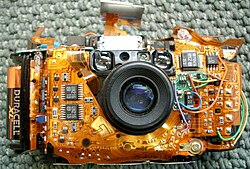 A more recent variation on flexible circuit technology is one called "flexible electronics" which commonly involves the integration of both active and passive functions in the processing. 1970's: LCI demonstrated the first LCDs, which initiated the multi-billion dollar flat panel display industry now dominated by Asia. later in the 1980's: Researchers at LCI began combining liquid crystals and polymers subsequently forming a partnership with the University of Akron and Case Western Reserve University to create the Center for Advanced Liquid Crystalline Optical Materials (ALCOM).
Flexible electronics have until recently been utilize for saving space, the use of bendable circuit boards for surface mounted components have evolved from Sculptured flex circuits to Double-sided flex circuits on from Multilayer flex circuits to Polymer thick film (PTF). Flex circuits are true printed circuits in that the conductors are actually printed onto a polymer base film. They are typically single conductor layer structures, however two or more metal layers can be printed sequentially with insulating layers printed between printed conductor layers. While lower in conductor conductivity and thus not suitable for all applications, PTF circuits have successfully served in a wide range of low power applications at slightly higher voltages. Keyboards are a common application, however, there are a wide range of potential applications for this cost effective approach to flex circuit manufacture.

Modern methods of measuring the body's activty, such as electroencephalography (EEG), electrocardiography (ECG), and electromyography (EMG), use electrical signals to measure changes in brain, heart, and muscle activity, respectively. Unfortunately, they rely on bulky and uncomfortable electrodes that are mounted using adhesive tape and conductive gel or even needles. Because of this, these types of measurements are limited to research and hospital settings and typically used over short periods of time because the contacts can irritate skin.
A team, led by Zhenan Bao of Stanford University, has been working toward making stretchy, artificial skins from rubber and carbon nanotubes. The skins will feel like the real thing to the touch and they will have a sense of touch too, electronically detecting changes in strain and pressure from a stretch or a pinch.
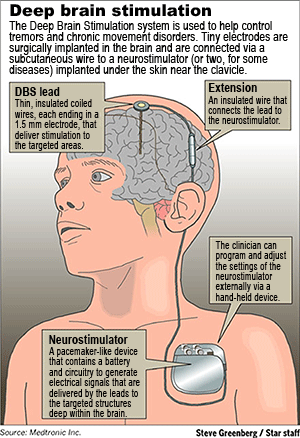
In the short term, flexible, stretchable electronics could help make medical devices smarter, by integrating sensors into sutures, surgical gloves or balloon catheters that feel their way through the passageways of a heart. Incorporating electronics onto (and into) human bodies for everyday use may follow close behind.
Instead of trying to make traditional electronic materials flexible, Stanford’s Bao and colleagues are turning the goal around: They’re trying to make flexible materials electronic. By layering thin textured films with carbon nanotubes, Bao and her colleagues are figuring out how to make touch-sensitive artificial skin no rigid parts required. In many ways, Bao’s artificial skin behaves like the real thing. But it has one big hurdle to clear: It still uses wires to send its messages to a computer. If the skin ever made its way into a prosthetic, it would need to relay signals wirelessly to the wearer’s brain. “Ultimately we want the sensors to be talking directly to the neurons,” Bao says.
In 2010, John Rogers, Ph.D Fiorenzo Omenetto, Ph.D and colleagues tested a silk-coupled electronic device on a feline brain. They placed the silk-backed mesh circuit onto the visual cortex of an anesthetized cat and monitored brain activity. Compared to thicker devices, the mesh molded more closely to the brain and recorded stronger signals. In people, such flexible devices may one day control prosthetic arms, map brain activity or quell seizures in epileptic patients.
The simplest devices for recording from the brain are needle-like electrodes that can penetrate deep into brain tissue. More state-of-the-art devices, called micro-electrode arrays, consist of dozens of semi-flexible wire electrodes, usually fixed to rigid silicon grids that do not conform to the brain's shape. In people with epilepsy, the arrays could be used to detect when seizures first begin, and deliver pulses to shut the seizures down. In people with spinal cord injuries, the technology has promise for reading complex signals in the brain that direct movement, and routing those signals to healthy muscles or prosthetic devices.
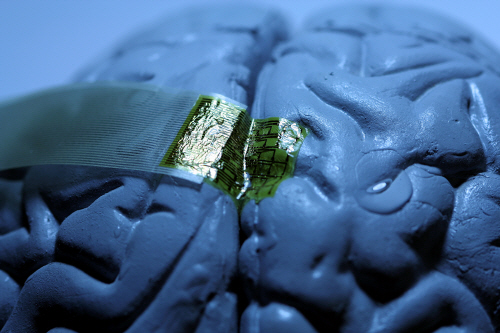 "These implants have the potential to maximize the contact between electrodes and brain tissue, while minimizing damage to the brain. They could provide a platform for a range of devices with applications in epilepsy, spinal cord injuries and other neurological disorders," said Walter Koroshetz, M.D., deputy director of the National Institute of Neurological Disorders and Stroke (NINDS), part of the National Institutes of Health.
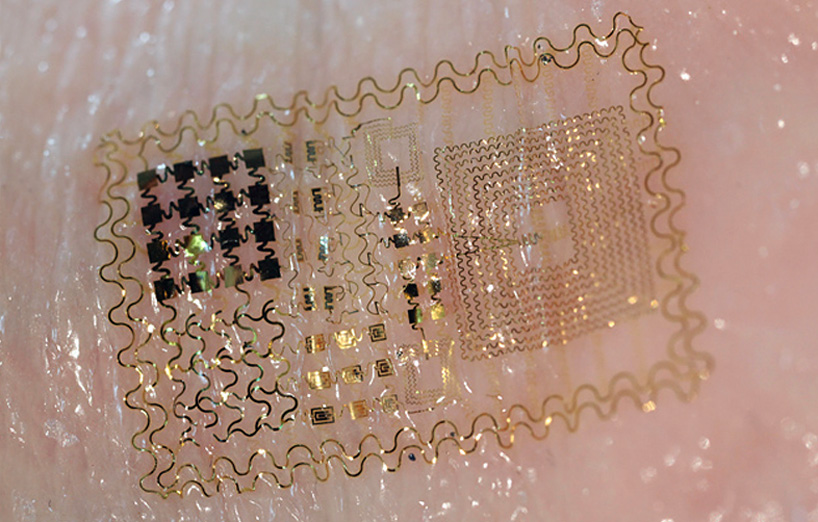
Evanston, Ill. Researchers from Northwestern University and the University of Illinois at Urbana-Champaign have developed “tattoo electronics” wireless electronics so flexible and thin they can be applied to the skin and forgotten. Yonggang Huang, who led the theory and design work at Northwestern, published in Science describes technology that allows electrical measurements (and other measurements, such as temperature and strain) using ultra-thin polymers with embedded circuit elements.
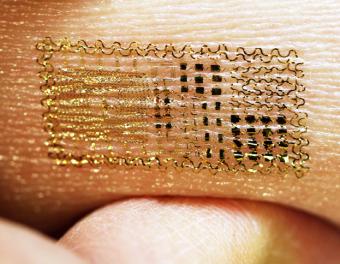 These devices connect to skin without adhesives, are practically unnoticeable, and can even be attached via temporary tattoo. All of the necessary components of the devices, including electrodes, electronic components, sensors, radio frequency communication components, and power supplies, are set within an extremely thin (about 30 μm) elastic polyester sheet. The sheet has a low elastic modulus (that is, it's flexible) and no noticeable mass (about 0.09 g), so you have a lightweight, stretchable membrane. Circuit elements (such as transistors, diodes, resistors) and sensors are constructed with typical materials like silicon and gallium arsenide, but are linked using nanoribbon and micro/nanomembrane elements to allow extremely small but flexible designs. The researchers refer to their approach as an "epidermal electronic system" (EES). The device matches the physical properties of the skin (such as stiffness), and its thickness matches that of skin features (wrinkles, creases, etc.).
The device adheres to skin only using van der Waals forces the forces of attraction between atoms and molecules so no adhesive material is required. Between the flexibility and the lack of adhesive, you wouldn’t really notice one of these attached.


Flexible electronics may have started as a means to save space, but it is now continuing to prove useful in the field of bioelectronics for medical use. The introduction of flexible wiring and components not only will allow the integration of man and machine, in perhaps computer peripherals. But the idea of electronic tattoos for visually stunning and possibly non medical use of skin augmentation for vain purposes. Many people feel the use of electric tattoos will allow electronic tagging for criminal or eventual population control and monitoring. It's unsure if electronics will get this sophisticated, although electronic tattoos might evolve into the ultimate form or expression in the same way we personalize our phones...